AI in CMMS is useful when it predicts which machine will fail next and turns that warning into a work order. It is hype when it promises to run your maintenance department on its own.
Every maintenance software vendor now calls its product an AI CMMS, an AI-powered CMMS or AI maintenance software. For a plant head or maintenance manager, that makes it hard to tell what is real. Is the "AI" a forecasting model trained on your equipment data, or a chatbot bolted onto an old work order screen?
This guide cuts through it. You will learn what artificial intelligence in a CMMS actually does on the shop floor, where it falls short, what data it needs from your plant, and how to evaluate AI CMMS software before you buy. If you already know you want to see it working on equipment like yours, you can book a 30-minute PlantOps360 demo at any point.
What is AI in CMMS?
AI in CMMS means using machine learning and other artificial intelligence techniques inside a computerized maintenance management system to predict failures, prioritise work and recommend actions, instead of only recording what happened.
A traditional CMMS is a system of record. It stores your asset register, preventive maintenance schedules, work orders, spare parts and maintenance history. It tells you what was done and what is due. It does not tell you what is about to go wrong.
An AI-based CMMS (also called an AI-driven, AI-enabled, intelligent or smart CMMS) adds a layer that learns from that same history, plus live data such as sensor readings, meter values and operator inspections. It looks for patterns that humans miss across thousands of records, then acts on them inside the maintenance workflow.
The three kinds of AI you will find in CMMS software
- Predictive models (machine learning). These learn the normal behaviour of an asset from vibration, temperature, pressure, current or runtime data, and flag deviations. This is the core of AI predictive maintenance.
- Pattern analysis on maintenance history. These scan past work orders, failure codes and downtime logs to find repeat failures, bad actors and root-cause clusters.
- Generative AI and natural-language assistants. These let technicians create work orders by voice or text, summarise long histories, draft checklists or search manuals in plain language.
Most real-world value today comes from the first two. Generative AI makes CMMS software easier to use, but it rarely prevents a breakdown on its own.
What AI-powered CMMS software actually does
A good AI CMMS does eight practical jobs, and every one of them ends in a maintenance action, not just a dashboard.
1. Predicts equipment failure before it happens
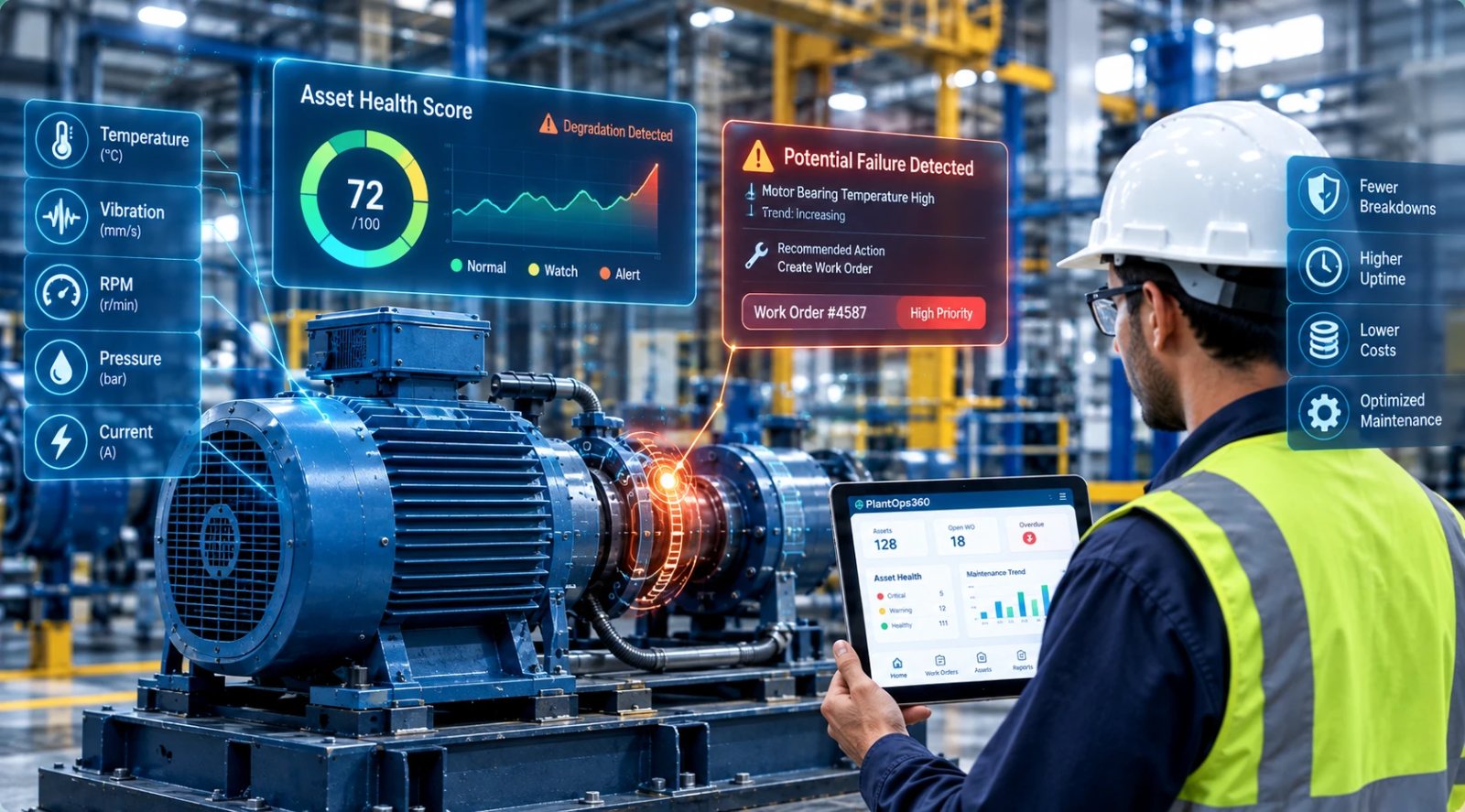
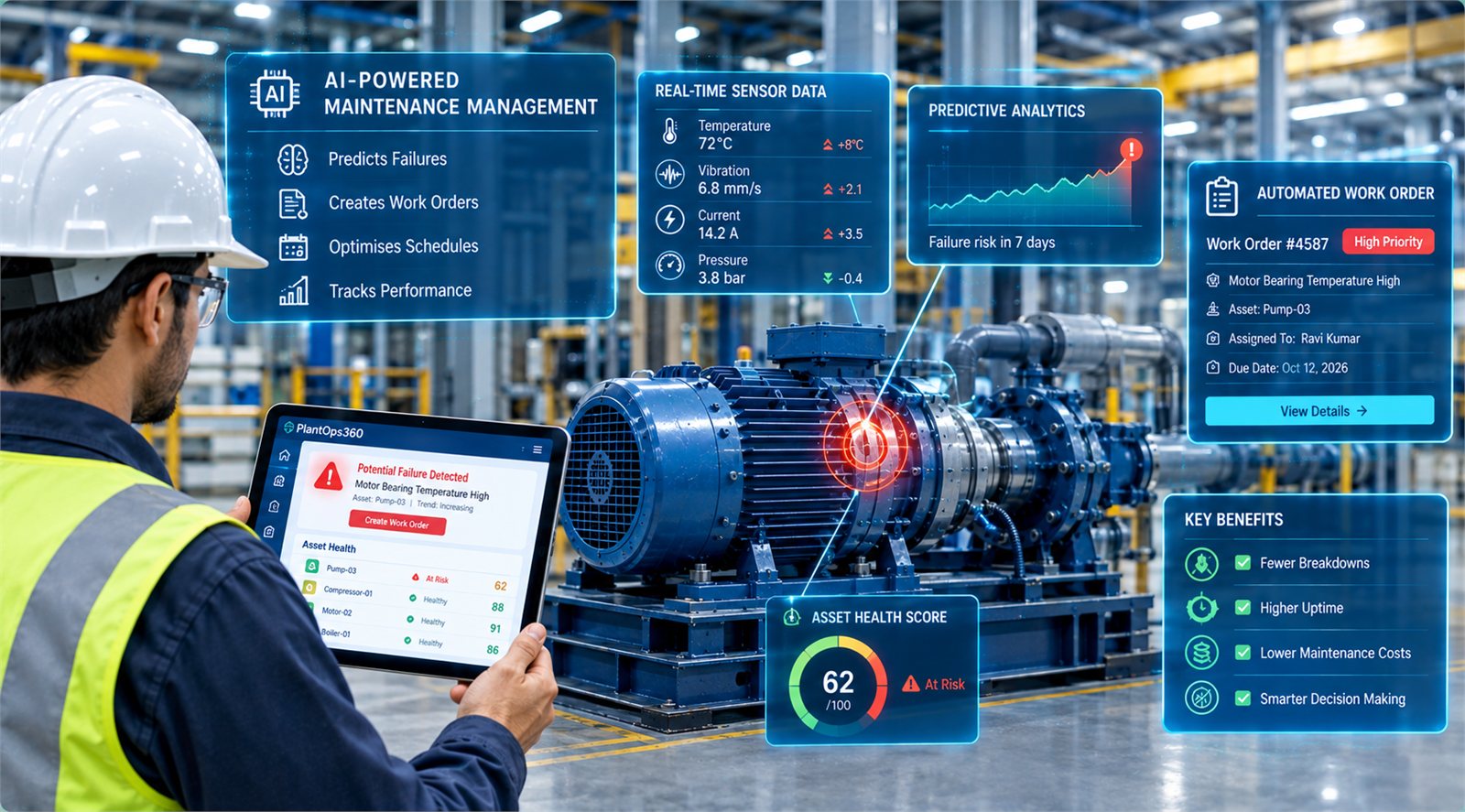
This is the headline feature of any AI maintenance management software. The system learns what "normal" looks like for each pump, motor, compressor or gearbox. When vibration creeps up, bearing temperature drifts or motor current spikes outside that pattern, it raises an alert days or weeks before the failure.
The practical result is simple: you replace a bearing during a planned stop instead of losing a shift to a seized motor. This is what buyers mean when they search for maintenance management software with equipment failure prediction or software to predict equipment failures in real time.
2. Turns alerts into work orders automatically
A prediction that sits on a dashboard helps nobody. AI work order management closes the loop. When the model flags a risk, the CMMS creates the work order, attaches the asset history and the reading that triggered it, sets priority and routes it to the right technician.
This is the biggest difference between AI in CMMS and a standalone condition monitoring tool. The insight and the action live in the same system.
3. Finds patterns in your failure history
Your CMMS already holds years of work orders. AI reads them at a scale no planner can. It answers questions such as:
- Which assets fail most often, and at what runtime?
- Which failure modes repeat after the same type of repair?
- Which shifts, product changeovers or operators see more breakdowns?
- Which "fixed" problems come back within 30 days?
These are your bad actors. Fixing the top 10 often removes a large share of unplanned downtime.
4. Recommends spare parts based on failure patterns
When the AI knows which components fail on which assets, it can recommend the parts a technician should carry for a job and the stock levels the stores team should keep. That means fewer trips back to stores, fewer emergency purchases and less cash locked in slow-moving inventory.
5. Optimises preventive maintenance schedules
Most PM schedules are set once from the OEM manual and never revisited. AI compares PM frequency with actual failure data. It shows where you over-maintain (wasting labour and parts) and where you under-maintain (and still get breakdowns), so you can move from fixed calendar PMs towards condition-based and predictive maintenance.
6. Prioritises the backlog
An AI-enabled CMMS can rank open work orders by risk: asset criticality, failure probability, production impact and safety. Planners stop firefighting by whoever shouts loudest and start with the jobs that protect output.
7. Speeds up troubleshooting and reduces MTTR
When a breakdown does happen, AI can surface similar past failures, the fix that worked and the parts used. Technicians reach the root cause faster, which cuts mean time to repair (MTTR).
8. Makes the CMMS easier to use
Generative AI and natural-language features help adoption: voice-to-work-order on the mobile app, auto-summaries of an asset's history, plain-language search across manuals and SOPs, and auto-drafted checklists. These do not predict failures, but a CMMS that technicians actually use produces the clean data that the predictive features depend on.
What AI in CMMS doesn't do
AI in maintenance management amplifies a disciplined maintenance team; it does not replace one. Knowing the limits protects you from overpriced promises.
It doesn't predict anything without data. A model needs history and signals. If work orders are closed with "done" and no failure code, or critical assets have no sensors or readings, the AI has nothing to learn from. Expect the first few months to be about data capture.
It doesn't replace your technicians or reliability engineers. AI flags a likely bearing failure. A technician still confirms it, plans the job and does the repair. Engineering judgement decides whether to run to the next shutdown or stop now.
It doesn't work equally well on every asset. Rotating equipment with clear signals (motors, pumps, fans, compressors, gearboxes) suits predictive maintenance best. Low-cost, non-critical or rarely used assets are often cheaper to run to failure or keep on a simple PM.
It doesn't fix a broken maintenance process. If PMs are skipped, spares are untracked and nobody owns the backlog, AI will only show you that chaos faster. Basic CMMS discipline comes first.
It isn't 100% accurate. Expect false alarms early on and occasional misses. Good AI CMMS software lets technicians mark an alert as valid or false, so the model improves over time.
It isn't magic "plug and play". Connecting sensors, PLCs, SCADA or historians takes some setup. Vendors who promise instant results on day one are overselling.
A chatbot is not predictive maintenance. Many tools now advertise "AI" because they added a generative AI assistant. Useful, but it is not the same as a CMMS with AI failure prediction. Always ask which kind of AI a vendor means.
Traditional CMMS vs AI CMMS: side-by-side
The difference between a traditional CMMS and an AI CMMS is the difference between recording maintenance and directing it.
| Area | Traditional CMMS | AI-powered CMMS |
|---|---|---|
| Core role | System of record | System of record plus decision support |
| Maintenance strategy | Reactive and calendar-based preventive | Condition-based and predictive |
| Failure detection | After breakdown or at the next PM | Early warning from data patterns |
| Work orders | Created manually | Auto-created from alerts, with context |
| Maintenance history | Stored, rarely analysed | Mined for repeat failures and root causes |
| PM frequency | Fixed from OEM manual | Tuned to actual failure data |
| Spare parts | Reorder points set by hand | Recommended from failure patterns |
| Backlog | First come, first served | Ranked by risk and criticality |
| Technician experience | Forms and menus | Mobile app, voice, plain-language search |
| Typical outcome | Better records | Less unplanned downtime |
What your plant needs before AI CMMS can work
You do not need perfect data to start with AI in CMMS, but you do need five basics in place.
- A clean asset register. Every critical asset listed once, with location, make, model and a criticality rating. AI cannot learn about an asset it cannot identify.
- Work orders closed with real detail. Failure code, cause, action taken, parts used and downtime hours. "Done" teaches the model nothing.
- Condition data on critical assets. Sensor readings (vibration, temperature, current), meter readings or even regular manual inspection values. Start with the 10 to 20 assets that stop production when they fail.
- A mobile habit on the shop floor. Technicians logging work on a mobile app, at the asset, produce far better data than paper sheets typed in at the end of the week.
- An owner for the alerts. Someone in planning or reliability who reviews AI alerts daily and decides what becomes a job.
If you have one to two years of reasonably complete work order history, you can usually get value from failure pattern analysis straight away. Sensor-based failure prediction typically needs a few weeks to a few months of readings per asset to learn a baseline.
Not sure where your plant stands? A PlantOps360 demo includes a quick data-readiness check against your current maintenance records.
AI in CMMS by industry
The AI is the same, but what it protects changes from plant to plant.
| Industry | Where AI in CMMS helps most | Typical critical assets |
|---|---|---|
| Pharmaceuticals | Calibration due-date risk, audit-ready histories, GMP compliance, HVAC and utility uptime | HVAC/AHUs, purified water systems, compressors, tablet presses |
| Chemicals | Early warning on pumps and agitators, safety-critical PM compliance | Pumps, reactors, agitators, heat exchangers |
| FMCG and food processing | Line uptime, changeover-related failures, hygiene PM | Filling and packing lines, conveyors, chillers, boilers |
| Power plants and energy utilities | Rotating equipment prediction, transformer inspections, regulatory records | Turbines, transformers, pumps, cooling towers |
| Plastics | Mould and machine failure patterns, hydraulic and heater issues | Injection moulding machines, extruders, chillers, dryers |
| Oil and gas | Compressor and pump prediction, safety-critical equipment, remote sites | Compressors, pumps, valves, rotating equipment |
| Manufacturing and automotive | Bottleneck machine uptime, spare parts planning | CNC machines, presses, robots, conveyors |
In every case the starting point is the same: identify the assets whose failure stops production or creates a safety or compliance risk, and point the AI there first.
How to evaluate AI CMMS software: a buyer's checklist
The best AI CMMS software for your plant is the one whose AI acts inside the maintenance workflow, on your data, and can show results on your assets. Use these questions in every vendor demo.
About the AI itself
- Which kind of AI is it: failure prediction, history analysis, generative AI, or all three?
- What data does the model use, and what happens if some assets have no sensors?
- Can it explain why it raised an alert (which reading, which pattern)?
- Can technicians mark alerts as valid or false so the model learns?
About the workflow
- Does an alert create a work order automatically, with priority and asset history attached?
- Does the CMMS handle the basics well: preventive maintenance, work orders, spare parts, calibration, documents?
- Is there a mobile app technicians will actually use, including offline?
About fit and rollout
- Does it integrate with your ERP (for example SAP), sensors, PLCs or SCADA?
- Does the vendor have experience in your industry?
- How long until the first useful predictions, and what do they need from your team?
- Is pricing clear, and can you start with a pilot on critical assets?
If a vendor cannot show the AI working on a realistic plant scenario during the demo, treat "AI-powered" as a marketing label.
How to measure the ROI of AI in maintenance
The return on an AI-powered CMMS shows up in five numbers you can already track. Record them before go-live so the improvement is provable.
| Metric | What to track | Why AI moves it |
|---|---|---|
| Unplanned downtime | Hours lost to breakdowns per month | Failures caught early become planned jobs |
| MTBF (mean time between failures) | Average runtime between breakdowns per asset | Repeat failures and root causes get fixed |
| MTTR (mean time to repair) | Average hours from breakdown to restart | Past fixes and parts surface instantly |
| Planned vs unplanned work ratio | Share of labour hours on planned jobs | Backlog is driven by risk, not emergencies |
| Spare parts spend | Emergency purchases and slow-moving stock value | Parts are planned from failure patterns |
A simple way to size the opportunity: take your hours of unplanned downtime last year, multiply by the cost of one hour of lost production, and ask what share an early warning could have turned into a planned stop. In many plants, preventing just two or three major breakdowns a year is enough to pay for the software.
How PlantOps360 uses AI in CMMS
PlantOps360 is an AI-powered CMMS and EAM platform built for plants, where the AI's job is to spot failure signs early and put the right work order in front of the right technician.
- Predictive maintenance: learns normal behaviour from your equipment data and flags early warning signs before they become breakdowns.
- Automatic work orders: an AI alert becomes a prioritised work order with the asset's history attached, so nothing waits on a dashboard.
- Preventive maintenance that adapts: schedules, checklists and PM compliance, tuned against real failure history.
- Asset management and materials: one asset register, full maintenance history and spare parts in the same system.
- Calibration and document management: audit-ready records for regulated industries such as pharma.
- Mobile app: technicians receive, update and close work at the asset, which feeds the AI clean data.
- SAP integration: connect maintenance with your ERP instead of running two disconnected systems.
See AI in CMMS working on your own equipment
In a 30-minute PlantOps360 demo, we will:
- Walk through how an early-warning alert becomes a work order.
- Show failure pattern analysis on a plant scenario from your industry.
- Review which of your critical assets would benefit most from predictive maintenance.
- Map a pilot you could run in weeks, not months.
Frequently asked questions about AI in CMMS
What is an AI CMMS?
An AI CMMS is a computerized maintenance management system that uses artificial intelligence to predict equipment failures, analyse maintenance history and recommend actions, not just store records. CMMS stands for computerized maintenance management system.
How is AI used in CMMS software?
AI is used in CMMS software to predict failures from equipment data, find repeat failure patterns in work order history, recommend spare parts, optimise PM schedules, prioritise the backlog and make the system easier to use through voice and natural-language features.
What is the difference between AI CMMS and predictive maintenance software?
Predictive maintenance software focuses on detecting failure signs in equipment data. An AI CMMS includes that capability and also manages the full maintenance workflow: work orders, PMs, spares, assets and history. The prediction and the repair live in one system.
Can a CMMS with AI predict equipment failures in real time?
Yes, when critical assets send live sensor or meter data to the CMMS. The AI compares each new reading with the asset's learned normal behaviour and raises an alert as soon as it drifts. Without live data, the AI can still predict risk from maintenance history, but less precisely.
What software identifies patterns in failure history?
An AI-powered CMMS identifies patterns in failure history by analysing past work orders, failure codes, downtime logs and parts used. It highlights repeat failures, bad-actor assets and likely root causes.
Is there technology that recommends parts based on common failure patterns?
Yes. AI-enabled CMMS software links failure modes to the components replaced, so it can recommend which spare parts a job needs and which items stores should keep in stock.
How does AI in CMMS reduce unplanned downtime?
It catches failure signs early, turns them into planned work orders, fixes repeat failures at the root and helps technicians repair faster. Each of these converts a surprise breakdown into a scheduled job.
How does an AI CMMS reduce mean time to repair (MTTR)?
When something breaks, the AI surfaces similar past failures, the fix that worked and the parts used. Technicians spend less time diagnosing and searching for spares.
Do I need sensors to use AI in maintenance management?
No, but they help. AI can start with work order history and manual readings. Adding sensors on your most critical rotating equipment unlocks real-time failure prediction.
Is AI CMMS suitable for small and mid-sized plants?
Yes. Start with a pilot on 10 to 20 critical assets. You do not need a data science team; the AI should be built into the CMMS and usable by planners and technicians.
Will AI replace maintenance technicians?
No. AI in CMMS tells your team where to look and when. Technicians still inspect, plan and repair. The goal is fewer emergency call-outs and more planned work.
Is generative AI in CMMS the same as predictive maintenance?
No. Generative AI helps people use the CMMS (writing work orders, summarising history, searching manuals). Predictive maintenance AI forecasts failures from equipment data. A strong AI CMMS offers both.
What should I look for in the best AI CMMS software?
Look for failure prediction that creates work orders automatically, explainable alerts, strong core CMMS features, a usable mobile app, ERP integration such as SAP, industry experience and a clear pilot plan.
How long does it take to see results from an AI-powered CMMS?
Pattern analysis on existing history can show insights within weeks of importing your data. Sensor-based prediction typically needs a few weeks to a few months of readings per asset to learn reliable baselines.
The bottom line
AI in CMMS is worth it when it predicts failures on your critical assets and turns those predictions into planned work. It is not worth it as a label on software that only records breakdowns after they happen.
Start small: clean up your asset register, close work orders with real detail, and pilot AI on the 10 to 20 machines that stop your line when they fail. The plants that do this move from firefighting to planned, predictable maintenance.
Ready to see what AI in CMMS looks like on your shop floor? Book a free 30-minute PlantOps360 demo and we will show you where AI can cut unplanned downtime in your plant.